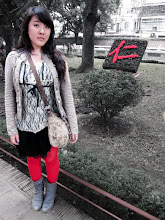
Wednesday, August 18, 2010

Shantih shantih shantih


your kiss
is a shallow grave

i am coming back

- Saul Williams, "She".


I've been in Texas for two days, will be at Yale in ten. Still waiting for the language to click back into place post-pledge. My thoughts, when verbal, flow in this tinny cacophony of Chinglish, English strung with Chinese in bright insistent bells. So I pause for a few seconds, leaden-tongued, to translate my emails inside my head, and I speak to my parents in their third-culture native tongue, which is neither here nor there.

This blog post is proof enough, of my old bashful ineloquence made weirder by the two months of no English-- my English now is bad poetry and rust. I think in cliches, in bizarre variegated metaphors. (This can't be the influence of Chinese, which is a language with propriety, certain adjectives pairing only with certain nouns in a courtship like a pavane.) I synesthete; I write on a slant, struggling.

Language pledge is liberation. Or, maybe just for me. (And people like me, by which I mean heritage speakers, or antsy, hackish sometimes-poets.) But what I've really missed is antimeria.

Again, I'm talking a lot, but I feel like I don't have anything to say. Have some pretty pictures of St. Sophia at night (when the kids play hackysack by the steps of the church and the moon is outshone by the streetlamps-- I have cut all this out of the frame). This is me trying to fulfill my obligations to Light and my promises to myself, in a way that feels tediously artificial. But I mean, that makes sense. I'm mildly jet-lagged, gingerly nostalgic, coming back into English, rapidly forgetting Chinese. Theoretically reading Harry Potter in translation in order to temper that last one.

Of course I miss my friends, especially the ones I won't see again in two weeks (although I think there's still the question of how I'll relate to them as Lucia, when they've known me for so long as Qiaopan). How lucky to be from the plurality institution, where dancing with Mary and talking literature with Young was a part of my life before Light. The others-- we've joked that we're more likely to run into eat other in China than anywhere stateside. Good thing America's government and her schools have such deep pockets when it comes to students of Chinese.

I miss being in a walkable city, having access to jianbing, mangosteens, and Korean food right down the street. I miss taking taxis to the tea market after class, making conversations en route with the cabbies who variously quizzed me on the US housing market or mistook me for Korean. But that's not enough to justify how I'm feeling now, wanting to go back as soon as possible. CET can't be recovered, but China can.

In a while (I promise hesitantly) I'll dissect this feeling some more-- this strange Saul Williamsian urgency to return to the motherland. It's not just that there's so much I haven't learned but want to, so much I still need to see-- these are all cliches, but they're true. And it's not that I like myself more in China. The opposite is true, I think. It's not that I'm more myself, just that I am more. For whatever reason, I'm a romantic only on Eastern soil-- a double-edged sword, but addictive enough I guess, like the strange sweetness of renshen wulong tea. I can't hold to that old pledge, feeling only socially productive emotions. But more on this later.

All of this is really terrible prose, I think-- hard to tell anymore. In Chinese I grew used to speaking in absolutes, in epigrams, like I'm swishing a fan or holding a sword all the time, like I'm projecting a faceful of operatic makeup. I've forgotten how to tone it down. Maybe I'm eager to go back so I can talk like a dramatis persona again, certainty issuing out of my mouth in speech bubbles, this dizzying unreignedness I don't allow myself in English.

I'll end with this-- thank you, Light/Greenberg. My words are clumsy and inadequate, but thanks all the same.

(I'll be back. My goal is to keep writing till I run out of the right lightly desaturated photos, and that might be a while in coming.)

Thursday, July 22, 2010

Weather-vane


I really shouldn't be a travel writer.

I'm realizing now how useless this blog will be to any baby Light Fellows (and Greenberg Scholars-- represent!) who happen to stumble upon it via the forum. I definitely creeped on some veteran blogs during the chaos of the application process, found all the commentary on academics and student life really helpful. I've totally failed to provide any of that, which makes me think I should do a round-up post sometime soon. Just not tonight.

I also start almost all my sentences with "I", which must be really annoying. That, and my bottomless love of navel-gazing. What I've provided you with (Dear imagined Reader!) is not so much a tour of Harbin via the transportive power of the Written Word, but rather a tour of the dream-mists and wildflower angsts inside my head.

Dream-mists. Wildflower angsts. What. Even I don't know what I'm talking about sometimes.

I'm not actually as bitter, as emotive as I might come across in these posts-- still the same ossified heart, the deep glassy moods like Lake Baikal, just couched in all this maudlin metaphor. Sometimes I feel so disingenuous, like I'm affecting this performance of sensitivity or something. So then I backtrack, reel in the rhetoric, qualify it into a even-dictioned moderation that better befits my emotional obtuseness. Which is also kind of annoying, all this pomo baring of the device.

Of course I remember that curve Kelly and Erica showed us. Mine is flattened out-- the little bumps I can meditate (literally or metaphorically) away.

But sometimes I catch myself watching myself in this stupid, unproductive way-- marking the driftings of my mind the way the wind is marked by a weather-vane. It's interesting. Despite all my avowed faith in mental self-discipline, I instinctively view everything I think, feel, believe as external forces, no more under my control than that gathering of dark clouds in the distance portending rain. When I ask myself whether I believe in God, or love, or Palestine's right to self-determination, I can take my answer and construct some clumsy, ill-informed justifications around it. But to find the answer, I use this inarticulate I-Ching mechanism, studying my own emotive drift with augury intent.

This is the mystic in me. It's hard to explain. A lot of the time I don't actually think in words, but in this rush of images accompanied by sensations of recognition or confusion-- there's nothing more frustrating than the feeling of really knowing something I can't articulate.

None of this explicitly relates to Harbin-- these are just little inanities I happen to have realized while I'm here. Maybe this is a side effect of the language pledge. I'm starting to realize how deeply I distrust language as a vehicle for the communication of anything truly worthwhile-- this, even though I love words, hope to be able to use them with something approaching grace one day. I think this is the secret Taoist inside me, who didn't understand the Dao De Jing, but nevertheless views with creeping contempt any Way that can be shoved inside the tiny box that is language. And so I grow increasingly uncomfortable with the rhetoric of transcendence. Which should provide much fodder for self-directed irritation, considering the undisciplined way I use big words.

I've been detecting other subtle shifts in my... Weltanschauung. Like how I've started identifying as Manchu, inexplicably, making me the Chinese equivalent of your blue-eyed blond who calls himself Cherokee on the basis of one ancient great-grandfather. My father's ancestors rode in with Nurhaci, if I understand right, under the Plain Red Banner-- all that's left of the Manchu warrior in this pampered daughter of the suburbs is my insistent stoicism, I guess. I feel kind of cheap, claiming that heritage without the language, but that's not my fault-- only fifty old guys in some village really speak Manchu anymore. Someday, if I really have a lot of time on my hands, I think I'll find someone to teach it to me.

Or maybe this is just one of those phases, a brief bout of collegiate hyperpostcolonialism.

And another thing-- I've started romanticizing Texas. Not just the grassroots-activism-and-indie-rock eco-urban beat of Austin but all of it-- the sunbeaten rocks and megachurches and even that imaginary line cleaving that western corner from the rest of the state, dividing Mountain Time from Central. These are things I've never experienced, obviously, so I can only lay claim on them the way I lay claim to being a Manchu. Probably this is my own fauxetic, emotionally distant brand of homesickness.

Friday, July 16, 2010

Doldrums


I was sick last week, spent most of Sunday bobbing in and out of syrupy slumber, the thick sleep of the infirm. I kept time by the jar of jasmine tea I’d steeped before succumbing to the doldrums, watched it go from pale to umber. By the time I woke up for real it was river-bottom colored, lukewarm and too bitter to drink.

I wasn’t the only one. Of course I remember the old joke, the words of Harold Bloom (on the other end of Ellen’s phone line, smoke-frail and punctuated by wispy little coughs, I assume): “These are dark days for Yale indeed.” Well, these were dark days for CET Harbin, everywhere ashen and trembling Americans, clutching their bellies and sipping at congee . It must have had something to do with our trip the weekend before, the Sunday we spent on Phoenix Mountain. Climbing a mountain before lunch will do that to you, I guess, especially if you’re fed questionable preparations of raw vegetables right after, and the mountain sky rains all over your sweat-drenched clothes just before your homeward journey.

So that was fun.

Not that I regret going. I didn’t even make it to the top. But for someone who's fiercest tussle with gravity was, until two weeks ago, the fifteen-minute trek up Science Hill, I think dragging myself halfway up those craggy steps by the cataracts is good enough. I mean, I’m the most spoiled specimen of suburban princesshood I know. I once brought high-heeled boots and a full complement of makeup to a monastic retreat in the Catskills— imagine my surprise when we ended up picking our way through these tangled paths by Woodstock, me rocking ridiculously on uneven ground with sequined hairbows in my braid. I haven’t had unpainted nails in at least three years.

I'm cool with nature, in theory. I think photos look best when they're not marred by human figures, and my favorite cliché is the sea. But I like to admire it from a distance. Give me painted sweeps of moor, or postcards prepackaging desert for enjoyment without sweat. I’m the kind of person who’d rather read a panegyric to Yellowstone than visit the place myself. No need to experience it, really— someone else, with finer sensibilities, has already done it better.

I wish I could say that Phoenix Mountain changed my mind. It was beautiful. But it was that sort of richly exploitable beauty, more thoroughly picked over by the creators of Romantic canvasses and Hallmark cards than any other iconography, except for the lone rose and the simpering cherub. The heaps of tourists, who shoved their elbows into our photos and punctured the stillness with their chatter—they just furthered my suspicions that the faux-pristine natural vista was so boorishly cliché.

Still beautiful, of course. Universal appeal. I could have been looking at Avalon, or Middle Earth, or… Ithaca. Which is part of the reason I would’ve rather been at the Summer Palace maybe, feeling another kind of anticlimax altogether. My approach to travel becomes, at times, a chain of tiresomely pseudointellectual defenses against disappointment. Someday, I’m afraid I’ll stand in front of the Hagia Sophia and feel nothing.

So maybe Yale has desensitized me to pretty things-- not to the sharp, concentrated charm of a rococo masterwork or a graceful turn of phrase, but to being immersed in prettiness all the time. Just a year of living in this unreal bubble that looks like a snowglobe in the winter and a period piece still the rest of the time. I can't describe beauty except in the most cynical terms.

I’m getting off track. That’s not at all what I meant to say— I’m still a little bit sick, probably, have had non-vegetarian meals only three times in seven days. Maybe part of the reason I didn’t get much out of the mountain on a visceral level was how aggressively I processed the whole experience, filtered it through all these layers of language and self-consciousness and memory-in-the-making. The whole time I was aware of how I would think about it afterward, what I could maybe write about it, how many photos I’d be able to take of the mists and rolling grasses to make all the sweat worthwhile. It’s really weird to ostensibly enjoy nature with an eye on the bottom line, but that’s what I was doing— robotically running the impact calculus, computing the psychological profit.

I just used the phrase “impact calculus”. Yeah.

Of course the whole time I’d shoved the experience back one remove, was watching myself from this insulated vantage point of narrative and disingenuousness. And it was stupid. I kind of forgot to really feel things— the way the glossy cold permeated my skin, gave it the chill smoothness of a river rock. How impersonal the babble of the cataracts sounded, as if we could do anything to the running water and it wouldn’t matter. See, this is the romantic in me, willfully submerged behind layers of hard-lacquered rationality (itself a pose, at least at one point) most of the time. My letting it show here is its own kind of disingenuousness, milking ossified emotion for the rhetorical possibilities. Really, I just like exploiting myself. And the results aren’t even that interesting.

Thursday, July 8, 2010

Memorial


This will be my last 731 post, I swear.

Professor Hu asked us about our visit after lit class last week. Some of the kids last year weren't too impressed, she said. They didn't think it was objective enough to be credible as a museum.

I didn't think of it as a museum, I said. I thought of it as a memorial.

Stale


I feel this lingering obligation to revisit 731, even though my impressions of the place have long since gone stale. Well, I've got a few minutes, and my laundry hamper's empty. Otherwise I'd probably snatch my blouses out and start running them under icy water-- China makes a domestic out of me every time I try to dodge the usual vocab lists and essay prompts.

So I figure, why not take the time to pound out some dada? I'm sure I can dredge up some angst, indignation, or ignorant presumptuousness, and serve them up warmed-over in some very ponderous sentences. Side note here, but I actually hate what China's doing to my writing style, which was admittedly always rather precious and brittle-- like those blue-eyed shepherdess figurines you see on retirees' mantle-pieces, all nostalgia and nausea. Fine Chinese prose is known for its succinctness, a compressed, high-concentration elegance like good brick tea. Not that I've managed to pick that up from reading motherlandic literature. (I cling to hope-- after reading White Oleander I emoted in sentence fragments and fragrant analogies for weeks.)

Instead, I find myself stalling, sometimes translating back from Chinese-- in which my style is arid, academic, and dead on top of being unsophisticated, wobbling between toddler and fossil to tragic aesthetic consequences, I'm sure. And I'm always untangling these syntactically ridiculous sentences that make me want to forfeit my right to the English language.

Blogging in this state of mildly farcical dissatisfaction-- no one angsts this much about their prose style, not even really me-- is actually kind of depressing. It draws attention to the floaty faux-profundity of my thoughts (How very small my mind!) as well as the pretentiousness of my prose (Stop that alliteration!). I go back and cut out words, and still there's this mass of modifiers and tongue-tied imprecision, growing out like a cancer. This is, I guess, a kind of stylistic anorexia-- resenting my sentences for their flabbiness, trying to starve them down. (I can't.) Healthier than some alternatives, I guess, since China makes me feel virtuous when I don't eat. (I do.) Not that I actually want to churn out Good Modern Prose-- what n+1's Elif Batuman calls "a nearly unreadable core of brisk verbs and vivid nouns". I'm with Batuman. Thank you, Hemingway, for being publishing's Kate Moss.

So I just quoted a literary journal in a blog post. And wrote too much about my tendency to write too much. And none of it was about Japan.

I should probably go back to the tea treatises tonight-- no more time for groundless ruminations on one of the most soul-crushingly depressing topics available to the East Asian intelligentsia. So I'll just say this, all pigheaded obviousness and fortune-cookie cliche:

It makes no sense to conflate the policies of the WWII-era Japanese imperial government (and the often reprehensible conduct of the associated military personnel-- ugh, total war) with the character of the Japanese people today. I hate that sentence, but whatever. It's not the same nation. Japanese schoolchildren-- against my expectations, actually-- are briefed about the atrocities in the classroom, and I'm told that Japanese newsrooms positively hum with debate about the extent of civilian culpability in the war crimes of the imperialist era. By raising its children to hate blindly-- broadcasting exploitation flicks set in Nanjing, boycotting Japanese goods-- China won't accomplish anything but win Japan's bewilderment and contempt. They're forcing the mask of enmity over Japan's face-- if we become what we pretend to be, don't we also become what others insist we are? It's especially annoying now that the generation flinging insults and accusations back and forth don't have any authentic memories of the war. They're mining TV show caricatures in order to manufacture evidence of one another's cruelty and incompetence.

I'm aware that talking about "China" and "Japan" as implicit monoliths is imprecise and stupid. It's a shortcut, a metonym, or something.

Dana and I talked about this on the bus over to 731. We were more or less in agreement about China's stubbornness-- Sichuan's being rebuilt using Japanese dollars, my one-on-one professor says. I claimed it had something to do with the old Confucianism-- the rectification of names. What China wants is for Japan to make everything right by calling a spade a spade. That's a crude oversimplication, sure. But would it kill Tokyo to use some more emphatic rhetoric in the various expressions of "remorse" they've already released? Maybe I don't understand because that's the way of the US-- this masturbatory performance of GUILT, theatrical and choreographed as a dance. I'm a consequentialist. Writing a poem about the Trail of Tears is easier than making change. (But is it easier than blindly tossing money at a problem? Also, I hate it when I find myself talking about "change" in such fuzzy, rhetorically shallow terms, as if I'm writing a pat political poem of my own. Blame it on ignorance-- I've got no idea what sort of change should be made.) You can bow your head before all the shrines in the world-- such actions are often significant as signals broadcasting the acceptance of accountability, and as gestures of humility. But they're not actually useful.

But I sometimes feel this stupidly personal sense of victimhood when someone brings up Manchukuo or Nanjing. My identification with China is visceral and blood-deep, even though intellectually I don't think much of the nation-state as a marker of identity. And I also have this weird thing about the medical profession-- romanticizing it to the extent that I could never be the doctor for fear of tumbling down dear old pedestals, venerating the Hippocratic Oath as a sort of personal Nicene Creed (even though I interpret it in this possibly problematic, lunch-buffet way-- support legalized abortion and euthanasia, after all). So I view the 731 experiments with the appropriate amount of horror, even if it's a horror of the intellect rather than of the tingling spine. Medical expertise was perverted for murder, shattering the doctrine of nonmaleficence which I'm wont to hold sacred.

Room 11, which I think of as the Redemption Room, holds artifacts related to the testimonies of former 731 personnel, who renounced their past crimes, released previously suppressed information, and tried to atone. They did things like give up their pensions, seek solace in Buddhism, allow themselves to be grilled by Chinese journalists. But I'm still wondering how they could have lived on after working 731. Primum non nocere.

Saturday, July 3, 2010

Unreal City


I don't cry a lot.

Wikipedia says the average frequency for women is five times per month. For me, it happens maybe twice a year. The last time it happened for real was a year ago-- Beijing in the summertime, silken whirring of a restaurant fan, jasmine tea and thin-sliced Manchu wraps spinning atop a Lazy Susan. Some of those details are probably confabulated. But I had cheap plywood chopsticks in my hands, and my dad was talking. I'd heard it before-- World War II history, Japanese war crimes, Manchuria and Nanking. I had a western in my purse, Larry McMurtry's Lonesome Dove. That detail is not confabulated. I'd just gotten to a good part so I kept fingering the pages, while my dad waved his hands with the violence of a helicopter blade.

We make the same kinds of gestures in debate, my dad and I, but though he relishes those kinds of confrontations I try to avoid them. There are things I disagree with my parents about. I'm not the kind to let them know. They called me when I was in Portland, canvassing for Maine's No on 1 campaign. When I told them what I was doing there I got this spiel on anomie, but I just slunk into silence and looked at the sky. Disagreements make me so uncomfortable-- that's probably really bad. I think it's because I'm so terrified of being wrong I'd qualify all my assertions into absurdity anyway, and my relativism is the relativism of a coward and a fool.

But that time-- Beijing in the summertime, teacups and flatbread on the Lazy Susan-- I didn't go quiet and look away. And then I was sitting with my shoulders hunched, trying to read Lonesome Dove with tears blurring my vision. My face was swollen red, people in the restaurant were looking, but I couldn't stop. I remember feeling horrified, in this floaty, outside-myself way, trying to remaster my own rebellious body. I wasn't even thinking about war crimes anymore.

And honestly, it's not the kind of thing I spent a time thinking about anyway. I'm a petty person of rather impoverished empathy, something I feel guilty about all the time. So at least there's that. But I'm still not sure why I got so angry, there at the dinner table. I'd made my opening statement in a vague offhand way, contesting my father's broad-brushed vilification of the Japanese people (probably just a sort of rhetorical pose). It was just a throwaway comment; I didn't want to launch a debate, especially one I'd quickly make personal with those strange, shameful tears-- shameful because of the misrepresentation.

I never meant to masquerade as a person of passion. And I can't tackle Sino-Japanese relations in a single post.

Yesterday we went to a museum, a little block of brown-brick buildings where Unit 731 once operated-- the Imperial Japanese Army's germ warfare division. The dim gray enclosures where rats were bred, germs cultured, and men killed by other men trained to heal (I reminded myself), had been scraped clean and fitted with explanatory placards in Chinese, Engrish, and Japanese. I'm still not quite sure what I felt, walking the silent perimeter in my sunglasses, holding up a pink-edged parasol. The sun beat down over a tumble of rocks and yellow-green vegetation. I thought of the heatwaves shimmering past Lost Alamos, and the scientists vomiting into scrub-brush when news of Hiroshima reached their desert labs, and Oppenheimer with his remorse and beautiful eyes. That resonance didn't jar anything in me. I reminded myself that I was walking around what was once a charnel house, but the slaughter was too distant to be imagined (too wicked to be imagined), and there was no weight in my chest or sting in my eyes.

Inside they'd stocked display cases with ceramic bombs, medical instruments, old documents, and dioramas. I was glad they hadn't depicted the Japanese doctors with leering faces, depersonalizing them instead with surgical masks. They looked like hastily made sculptures, impressionism in 3-D, just a twist of limbs in agony and the steady-handed slash of a knife. They were vivisection scenes.

And I kept thinking, they should've used white light instead of yellow. More jarring that way, in the sterile vein of medical horror-- they'd kept the walls rough for the verisimilitude. Maybe there really is something wrong with me.

I'll write a little more later. I'd got other tedious thoughts, about groupthink and redemption and memorialism and the potentially masturbatory nature of guilt-- tedious because someone has thought them all before, with more finesse and less confusion, and my own ineloquence will surely betray me again. But it's late, and I'm tired, and though my eyes are dry (and will be), I'm starting to feel a little...

Friday, June 25, 2010

Iron Goddess of Mercy


Thousand-armed Avalokitesvara, lord looking down from the Pure Lands toward the faithful at their prayers, moved northeast to China and became a woman-- Guanyin. In Fujian province by the South China Sea, they pick a tea named after her, Iron Goddess of Mercy-- tieguanyin. She's actually a bodhisattva, but whatever. I almost bought a cup during Reading Week at Jojo's, the little teashop near Davenport run by two Chinese women, who took my order in its hesitant Mandarin and asked me where I was from. I've got a little sitting on my bookshelf now, an inch of dark green looseleaf sitting in two nested paper cups. When I shake them, the tealeaves inside wash against each other with a cool sound like beads. They're twisted in shape-- misshapen origami stars, broken paper cranes.

I used to read perfume catalogs, collecting the adjectives. I was charmed by the idea of their transience, top note to base note, mimosa fading as the minutes passed so you could smell the amber underneath. (Does fossilized resin have a scent? That's got to be a metaphor.) The obvious analogy is music, but I usually thought about it in terms of how planned the whole experience was, the fragrances unraveling as preordained. Cue tacky metaphor-- choreographed chemistry. But when I lift the cup of tieguanyin over my face and inhale, I don't have the right words for the scent. Musky? Oriental? A salt tang and an evocation of mist. None of that's right. I won't be able to get a job writing copy for those catalogs, have yet to learn the dialect of perfume.

But I'd like to bottle that scent, wear it in two dashes along my wrist. Iron Goddess of Mercy. I'll leave it in the cup for a while, exuding inert scent.

I got it at a guest lecture a few of us went to last week-- an expert on tea culture expounding on the variations of China's favorite drink (making ever finer distinctions) to a PowerPoint that flashed past so quickly I could never make my way to be bottom of the text. I understood about half. Then a woman from the Center for Tea Culture (rough translation) performed a short tea ceremony, made a small pot of tieguanyin and poured it out for the first row. Her mandarin-collared top, singsong declamations, and dance-like movements (down to the way she flicked her wrist to release a carefully controlled stream of hot water) were so obviously performative, it was hard to connect her actions to anything I might do in a Yale dorm with a bag of Tazo and a hot water heater. Afterward, we were given cups of fresh-brewed tea to sample, allowed to scoop some tieguanyin to take home.

The lecture was planned by one of the student orgs, a group of material engineers to which fellow Yalie Dana's roommate belongs. When we got there, the room was full, but a nice berth at the front had been cleared for us (Dana's the only blonde head in the room, a photographer with his Canon Rebel pointing his camera at us and snapping publicity photos again, again, as I strive to look attentive). After the lecture, the good-natured engineers circled Dana and Aisha and quizzed them over the six different types of tea. Chishio and I, being obviously Asian in phenotype, were given less notice, although I did get the usual. (Are you Korean? No, but everyone thinks that.)

Being mistaken for Korean was already kind of a running joke with me in America. Something about the thick, square-framed glasses, the straight-cut bangs and permed hair? But in Harbin, it happens roughly twice a day-- every time I make the acquaintance of someone new, every time I strike up a conversation with a fuwuyuan as I'm being served food or directed to the right aisle of the supermarket. On the one hand, I'm faintly flattered-- Young, another Yalie with whom I took Tina Lu's Chinese lit course, said she thought I was Korean all term because of my clothes. Hey, that's pretty cool, Korean women are famously stylish. On the other hand, I wonder what it means about my Chinese. My aunt (actually the wife of my father's cousin) claims there's something off in the rhythm of my speech-- too even, as if I'm chanting sutras or intoning aloud a freshly memorized text. I don't have the jarring tones of an American accent, but there's still that element of foreignness.

I'm wondering if that foreignness is being reinforced by the language pledge. I find myself speaking really slowly so the other students can understand me, sounding singsong or robotic by turns. There's a trade-off-- it forces me to think more about my diction, makes it more precise. It's not that I'm better at Chinese than anyone else-- there are plenty of students who read at a higher level, students who used more polished syntax in speech even if their pronunciation is less accurate. It's a form of cultural privilege (a word I can never say without smirking slightly, because I'm aware I've... got it? Because my use of it will mark me as something admirable but typically, fashionably collegiate...?).

Both my parents were Dongbeiren who spoke CCTV-standard Mandarin; I grew up without the linguistic baggage of a Southern accent, a Tianjin twang, a Cantonese intonation. It means that, when it comes to Chinese, the things I'm good at are fairly showy-- so much so that I worry about becoming a section asshole. The things I suck at, though, are easily hidden away. You'd have to watch me struggle over my readings to find out how few characters I actually recognize, or ask me how many words in that essay I had to look up online. I think my proficiency at spoken Chinese may be masking my actual linguistic deficiencies. And it's faintly humbling that what I'm good at, I'm good at through an accident of birth-- running start, no doing of my own.

I'm grateful, though. It makes this whole language pledge thing a lot less painful. In our last minute of English, Rusty gave an extemporaneous speech compared it to having a cigarette put out on your arm for two months continuously. We all clapped, glanced sideways at each other. Young wished me good luck, and I told her goodbye.

But honestly, it's been a week. It's not that bad. Sometimes I wonder at its efficacy-- great for learning to communicate at any possible cost, potentially problematic if you want to master legit shu1mian4yu3 because we default to ridiculous circumlocutions and sometimes even buffoonish gesturing. I actually feel slightly guilty about how not-restrictive it feels, as if I'm not experiencing enough adversity to grow as a person, or something. I guess I've got some faintly masochistic tendencies. The pain the feels productive becomes an anticipatory pleasure. Also, I overuse the modifier "faintly".

Of course I've slipped a little. Not in conversation-- just letting loose filler words, curses, uncaught. Don't have any viable Chinese-language replacements, yet. What's interesting, if not entirely surprising, is that I'm more talkative in Chinese. There's no pressure to be articulate. In English, I always felt the need to make my every comment not only accurate but also eloquent, so that I rarely spoke in class. My standards for myself are lower here. Come to think of it, I may have the language pledge to thank for that. I think on balance it's still a useful thing, although we're all slightly unclear on some of the details. Are loanwords allowed? Proper nouns? At a Korean restaurant, we had a tortuous but amusing conversation on western philosophy during which we tried to Sinify a bunch of names likely to show up on a DS syllabus, unsure whether "Lucretius" counted as a violation of the pledge.

Tuesday, June 22, 2010

Retrospection


I've been awfully remiss about taking pictures in Harbin, despite previous claims to compulsive photography, so I'm photodumping Beijing again. More text to come on coursework, language pledge, culture shock (or a surprising lack thereof), Marxism, New Modern Confucianism, oolong tea, translingual friendships, or some combination thereof.

Monday, June 21, 2010

Tardy


I'd been late to every activity so far, so today I overcompensated by showing up disgusting early to most of my classes. Finally made it over the Great Firewall here in Harbin, the alleged "Paris of the (Chinese) Northeast", a designation born of wishful thinking and Small Reference Pools. Taking a study break to post some pictures from Beijing.

Tuesday, June 15, 2010

Habit Formation

In middle school, I was part of a drill/dance team.

It's a Texas thing. Fight songs, Friday night lights, and stadium heat-- our curricular calendars revolving around the glitzy triad of football team, marching band, and red-lipped ladies in jazz shoes. I remember applying to my face a very precise permutation of warpaint, dictated by our director to the very brand and color (on the waterline went a Maybelline highlighter in some wintery shade, maybe "Alpine Snow"?)-- a hassle that put me off makeup-as-streetwear till sophomore year of high school. I could kick pretty high, struggled with sticking my double, showed very discernably almost no dance talent. I still have my right split, but whatever grace I might have accrued has been outgrown, just like I've outgrown those spangled red gauntlets and flesh-colored tights.

Since I've come to China, I've noticed an old drill team habit resurfacing, in the supermarket aisles and the smoky plazas crowded with pedestrians. I stand with my hands at my waist, thumbs pointing forward and fingers braced at the small of my back-- the way I filed into so many high-kick lines to brassy music, on that little yellow field by the high school. It's whatever. My stint as a Crimson Cadet wasn't a very formative experience in general. I can only guess this has something to do with how awkward I felt, shaking my silvery poms around the field lines and being told to "project"-- to smile my disconcerting jack o'lantern grin at the highest row of the bleachers. I feel awkward like that in China, a little helpless and vaguely like performing. My American-ness, unverifiable by yellow hair or obvious accent, slips on and off me like a drill team grin.

We went to the local market, which has changed surprisingly little since this time last year, the same fashions still arrayed on the silvery mannequins. The puff-sleeved dress in which I posed in front of a snowy Branford courtyard with Laura and Caroline still hangs on its rack, in mint-green, slate, and purple. I bought another dress, its bodice proclaiming in felted all-caps, "NO ONE SEEMS TO UNDERSTAND THE PROJECT." I find it charmingly cryptic, and anyway it's neither obscene nor (gasp) ungrammatical, so yeah.

In my perpetual quest for little beauties I found also this: a bin of lovely apples, with a matte satin finish and a porcelain pallor, as if someone had dragged them onto a .psd and toggled the saturation bar far to the left. Which is exactly what I'd like to do with my world, most of the time. "Life," I've said out loud a lot-- it's the sort of social misstep I make with alacrity in good company-- "looks best lightly desaturated and tilted towards blue." We didn't buy any. I didn't think they'd be as good to eat as they were to look at.

I've started wondering about CET Harbin. As a newbie Light Fellow, I've got no idea with it means to attend an intensive language program. When I try to picture it, I get some composite of Xu laoshi's L3 heritage class (a cult) and TASP (the only sleepaway camp I've ever been to, though hardly representative of that summery genre of experience... also a cult). I hate making generalizations based such a scanty sample of n=2 (which hasn't stopped me in the past), but I guess it'll be cultish? I'm a little bit afraid I'll bomb my placement test with such aplomb that the resident director (a biffle of some cousin of my father's, apparently-- Harbin-as-homecoming means for me a very small world) will mournfully rescind my acceptance. And there's the matter of full immersion. I've developed the boorish habit of volleying curses in sotto voce when I can't make myself understood. Usually this happens when I try to explain something internetty to my grandmother (something that'd be nigh-impossible even if I spoke perfect Chinese or she perfect English), a situation unlikely to arise in Harbin. But still. I won't have that luxury under language pledge.

As least blogging is becoming (almost disturbingly) easy. I've got this tendency to navel-gaze when I'm not surrounded by more interesting thinkers, who keep me flitting around the edges of their ideas instead of submerging myself in my own banal ones. Without that constant hum of distraction, that tendency's coming out. I've discovered something about myself as a result-- I've got a really irritating prose style. It seems to get at once primmer and doughier by the day; eventually I'll find myself producing the most impenetrably convoluted Victorianesque fare (because my soul strains naturally towards more decorous times), as my engagement with the English language fades. So, sorry, Dear Reader. (Isn't that whole direct address thing the most annoying Victorianism ever?)

Monday, June 14, 2010

My rampant consumerism is a constant no matter where I go.

I just spent a very long car ride singing along to Lady Gaga with my cousin Siran (alias Christina), who will leave for a study abroad program in Washington, D.C. four days after I depart for Austin. Things other than "Bad Romance" to rise in Chinese popularity: OPI nail lacquer and the Twilight saga. According to Siran, one look at Robert Pattinson's pearl-dusted jaw and Kristen Stewart's insomniatic eyes will cause the high schoolers of Beijing to start frantically tan lian ai. That's the Chinese idiom for dating, which I guess transliterates to something like "discussing romantic love". I find little quirks of speech like that charming (condescending of me?), picture powdered belles and dandies draped in rococo silks, sipping coffee out of crystals and talking eros a la salon. I just wish I knew some more.

I went shopping with my aunt, Jingxue, my father's youngest sister. First we made the obligatory trip to Hongqiao, the ostensible "Pearl Market" glutted with all manner of Maoist kitsch, knockoff Burberrys, and Guanyin pendants in addition to the titular pearls. It's a kind of soft landing into Chinese culture-- the place is always full of foreigners, negotiating the matrix of temptations in English whatever their native tongues. (How lucky I feel to speak commerce's lingua franca.) All the shopkeepers are savvy to that, shouting out words like "price" and "low" (not in that order) they probably plucked from some phrasebook. Next we went to Wangjing, where my aunt lives. I'm not sure whether it bears to Beijing the same relation Cedar Park does to Austin or Manhattan does to New York, whether exurb or borough. I do know it has a high Korean population-- we wandered around a commercial center in one of the Koreatowns looking at hairclips too gaudy and slips too narrow for me to wear.

My aunt commented that, even when I spoke no English, the shopkeepers could sense that I wasn't quite Chinese. Maybe I should set a formal goal of working on that or something. I don't want to get ripped off for the weird treacherous foreignness clinging to my face (or whatever), even if I figure getting hoodwinked in a Beijing flea market has gotta be more cost-effective than bargain-hunting in Texas.

I've got two more days in Beijing, one of which I'll spend at the Qianmen Hotel with the CET group. I'm ready to go. I've spent the past week being treated like a not-quite-person, with all my relatives' kindest intentions. I love my extended family (or something; not knowing them too well, it's the kind of abstract love distilled out of obligation and respect for tradition, only slightly more felt than my love for the US Constitution). And I'm not saying I'm totally ready to navigate China without anyone holding my hand (metaphorically, except at busy intersections.) But all the attention, the well-intentioned advice, the warnings repeated again and again by different concatenations of concerned voices-- it's getting oppressive.

Sunday, June 13, 2010

Beijing

So here's a cliche: life is not art. It's messier.

I can't help but find this distressing. I'm the sort of person who adores coincidence, who sifts through the raw material of happenstance in search of patterns with some narrative potential. (It's the aspiring novelist in me, whom I've been killing inch by gentle inch for the past three years or something, a kind of euthanasia of which I'm not proud. The only thing I value more than useless pretty things is utility.) I love arc words, use them frequently and clumsily in writing. Because experience doesn't come with its own leitmotifs or ominous echoes, my interior monologue provides a suitably gaudy score.

Even by casting myself as this compulsive orderer, Rumpelstilskin spinner raveling the undifferentiated minutes into storied thread (ouch, tacky metaphor), I'm committing the exact sin I'm talking about. It's more complicated than that. I like the aesthetic of chaos. There's nothing like the studied randomness of falling glitter, grab a handful and let the spangled flakes scatter. Snowstorms, nebulae, Yale housing: I just can't pull that off. So, crystal lattices instead.

But I guess my time here in Beijing (slate-colored, muggy, the full-length jeans I packed for Harbin damp with sweat-- but hey, I'm a Texan, it isn't heat till you think of Hell) won't lend itself to that kind of pretty order. Here there is no even pacing, Freytag's Pyramid, that sort of thing. (Someday, I'll stop thinking of myself as the shy, Prufrockian protagonist of some modern novel. Storybook heroes don't act like me anyway-- they emote more, and have prettier eyes.) Maybe instead I'll adopt a vaguely stream-of-consciousness approach, which'll be a nice excuse to have my slavish adherence to conventional mechanics drop away a few paragraphs down. A few years ago I texted in MLA style. All points of pride soften; all habits lose their shape with time. (Looks like I interpret stream-of-consciousness as "the generation of tacky truisms". I'm a cliche factory. If I lampshade it, it's okay.)

I'm wondering if I sound a little bit insane. I've been in Beijing for three days now, and I haven't talked to a person under forty since I taxied into the airport next to fellow Stiles sophomore Jason Kuo. I guess that's a decent coincidence-- I sat the first leg of the journey next to my little sister's bandmate, who visited my house for at least one Asian party, the sort where expat engineers guzzle iced Tsingtaos and attempt Celine Dion karaoke. The flight I took from Austin to Newark was aswarm with family friends, the other full of Light Fellows. The twelve hours in flight were less painful than I remembered from similar motherlandic journeys with the nuclear family, sister asking for ETA at hour-long intervals while I tried to read. This time I bobbed in and out of a syrupy sleep while Jason next to me looked over his textbook, reminding me of exactly how much vocabulary had likely leached out of my head since finals week. My PRC passport exempted me from filling out the arrival card-- lucky, since they pretty much ran out of pens two rows in. A bilingual flight attendant with a Taiwanese accent and a Jay Chou haircut came through repeated with a beverage cart. Each time I asked him for hot tea, which I hadn't drunk since Yale, in Chinese.

Beijing itself seems to have clung to its hard-won post-Olympic sheen. The flashbulb image of it I carry in my head is something like six years out of date, from the first time I visited, when muddy styrofoam cartons half-full of food littered the roadsides and what looked like mules mixed with Mazdas on the streets. Probably it's confabulated with Tianjin, Harbin, Jiamusi-- one of the other cities I visited. My aunt's property in Lumingyuan is especially well-appointed. Olympic pairs figure-skating champion Zhao Hongbo was a neighbor; maybe he still is. We met him the last time I was here, and he signed a publicity photo after we watched him glide around the local rink to a flashy orchestral arrangement of "Nessum Dorma". Not realizing the depth of his celebrity, I seem to have misplaced it.

One thing hasn't changed. My hair is the right color, and I go around shielding my face from the sun with a scalloped parasol, just like a native girl. So when I ask someone to repeat what they said or can't manage to read a menu (in Yale L3 they give us the dictive tools to talk politics and revolution, not order dimsum), I probably give the impression of being rather stupid. Or hey, maybe they just think I'm Korean.

Tuesday, June 8, 2010

Et, O ces voix d'enfants, chantant dans la coupole!

I’ve had that line stuck in my head all day, something about the voices of children singing in a dome. Had to look it up, because I don’t know French— just the dregs of Spanish (Texican, really) that stayed in the sieve of my mind after that AP test. The one meek protest I can still trot out thanks to all those readings, Neruda and Marquez— “Ya no hablo español despues del examen de AP”. If I’d had to guess, I would’ve figured “couple” for coupole, “dance” for dans, forgetting that extra “e” that goes with macabre, russe. False friends, Blind Idiot Translation. For Matthew 26:41: the vodka is good but the meat is rotten.

Today I helped my mom find a Russian-to-Chinese translator, to riddle out some Cyrillic sig left on her coworker’s email. She went to high school in Jiamusi, just a pinkie’s span from the Russian border on this map I just googled; she fell into Russian classes the way this Texan fell into Spanish. But she’s forgotten by now the words for “goodnight”, forgot even the phonemes link to the script, couldn’t sound it out.

Spanish at least uses the Latin alphabet. But if math is a language like any other (its poetry I never learned to parse, O boorish bathos of a silly “humanist”, trying to romanticize things she’ll never understand!) then I’ve lost it the way my mom lost Russian. Even the signs grown foreign, can hardly sound them out. Never mind what all those symbols mean.

I keep Chinese I think because it’s a matter of blood, a matter of pride. (Self-styled rational obsessed with honor, because it comes in a double dose, I’m Southern and Chinese. And neither a belle nor a junzi will bow for the wrong reasons— I like this story, pretty if untrue.) If I close my eyes to it for just a little while, a week a year or three, it’s scary how quickly I start to forget.

Just think of this as a prose poem, a license for pretentiousness. Pretension? Whatever. And I forgot the most important part: two days till departure.

Monday, May 31, 2010

Rambling to Rectify?

I’ve got this inordinate distaste for adultery.

That’s probably not unusual. The God of Abraham agrees with me here, and He is— as the Texas Board of Education will have me believe— the great codifier of our star-spangled moral code. (This despite all those lawmakers who forsake their marriages with charming and well-coiffed wives for a few hours with a prostitute smelling of Chanel No. 5.) Not that I count myself among the People of the Book. I object to adultery because I’ve got this aesthetic preference for proper Confucian families, which parallel in their adorable orderliness the master’s proper well-run state. And also because I fangirl King Arthur, partially out of pity. The man tries to found a New Order based on fair rule and social justice, but then his wife has to sleep with his biffle? Lancelot, it’s not that hard to not fornicate with your liege-lord’s consort. Just don’t do it.

I don’t understand adulterers. From where I’m sitting, it’s always easier to cleave to the status quo; any deviation from that norm just makes things harder than they have to be. Seriously, Sir Knight, why expend all that energy cuckolding your king? Allocate it towards acts of gallantry or something— that’s what you’re supposed to be doing.

I promise I’m not actually a conservative moralist. Those last three paragraphs of inane reactionary rambling were designed to illustrate one thing (in the most obfuscatory way possible, because that’s how I roll). Writing is hard. Because it’s not my status quo. I guess I’ll have to keep blogging until it becomes so or something. Then I’ll no longer feel like a fidgety adulteress, allocating unnecessary time away from mindless Facebook procrastination and readings of sketchily translated motherlandic philosophy. Okay, I think that metaphor just broke down.

I remember when writing used to help me put my thoughts in order. I’d sit for a little while spellbound by the keyboard rattle of structure and narrative and (sometimes) poetry emerging from the tangle of sensations in my head. It was nice, like unsnarling a knotted skein of thread. I keep meaning to try to recover that feeling. Here goes?

My parents and I have this running joke, stemming from their occasional anxieties over whether immigration was the right decision for our family. “Well, think about it,” I say, whenever this comes up. “If you’d stayed in China, I’d be thinner and better at math!” And they’d laugh, remembering the charcoal skies of Beijing, the mind-numbing hell of the gaokao, all those tacky “opportunity” slogans Immigration Services like to put on their eagle posters, because they’re true.

I say my canned response is a joke, funny because it’s true but largely inconsequential. But these are, after all, the two respects in which I’ve failed. The two ways I’m subverting the model minority stereotype— contributing so much to the advancement of the APA community just by being quantitatively challenged and fat! I say that last bit largely without bitterness— I mean, I am less bitter than I sound. Anyway, I guess I make up for it in other ways. I drink my tea unadulterated by sugar, I can quote from the Analects, and I’m handy with a mouse and filters.

For the most part, I can bury these insecurities under projects of various kinds— I’d rather be productive than pretty, which is convenient, productivity being mostly within my reach. But when I’m in China, I can’t help but feel shamefully out of place. I’m remembering again how I walked through Beijing with my breath held taut, trying to take up as little space as possible. Which was hard, what with my stout oafish limbs and the crude voluminous outline of my hips, in comparison to the gazelle girls who moved past me with easy grace. When everyone looks like me in other ways— the dark eyes with epicanthic folds, the inky hair— the contrast becomes biting. So I'm realizing that I’m a teenager after all, for a little while longer, with all the irritating shallowness and insecurity that implies. Hopefully I can keep that tempered. I don't do angst; it's so indecorous.

Part of this stems from this question I sometimes turn over in my mind, pointlessly, like I’m toying with a bauble— would I rather by invisible or beautiful? The former entails greater freedom and would be easier, for me at least, to achieve. But the latter implies to me a tantalizing degree of control over both the self and the environment, and an artistic process— converting persona into objet d’art. Anyway, to frame that question in the most narrow and literalistic way possible— in China I can be neither. I’m just preparing myself to feel the resulting downtick again this summer.

Sunday, May 23, 2010

Nostos for Return

In three weeks I’ll leave for the motherland on a Yale-funded flight, but I thought I’d start blogging now. Something to ease myself into this whole writing-with-regularity thing, before I fall under nigh-contractual obligation to report weekly from the province of my birth. Here I should insert some wistful encomium to Heilongjiang— the Black Dragon River, cold Amur, under whose frothing and watercrested shadow I guess I toddled my first steps. "Frothing and watercrested shadow"-- yeah, I think that's fauxetic enough. Maybe I should angst over how I don’t remember anything— just a soft, sooty impression of dark and narrow buildings, which sheltered me for the first three years of my life. For all the other Yalies going to CET Harbin, the trip to Dongbei—the far Northeast— will be a novelty. But me— I guess I'll be coming home.

That’s why I’m so glad Light encourages blogging. I mean, I’m the flakiest diarist ever. I’ve got a closet full of half-filled journals, covered with the glitter of elementary school, the baroque florals of middle school, the slick faux leather of high school. I could see my handwriting evolving but never my (lack of) perseverance, always too scared of the blank page’s white insistence. But maybe this will be okay. Half of blogging is photoblogging, and I live with my Canon Powershot strapped to my wrist, compulsively clicking at every banal beatitude and dust-mote tragedy I encounter, because I hate to be hostage to my own memory.

I don’t remember things very clearly— I’ve forgotten Harbin. I went back one summer with my parents, three years ago. We sipped kvass, fermented bread drink, as we wound between bakers’ stalls in the morning market, and I stared through the lens of my camera at the onion-domed Church of St. Sophia. I learned to talk a little bit like a Dongbeiren, a real Northeasterner, but Harbin itself lingered on in my weakish memory as nothing more than dreamy Russophile haze. It’s all cobble-stoned streets, with signs subtitled in Cyrillic.

I don’t want to forget this time. Writing weekly will help me keep a record, as long as I can stick with it this time. I hope this blog doesn’t become another powder blue notebook shoved under my faded summer dresses, filled with just five pages of impatient script.